
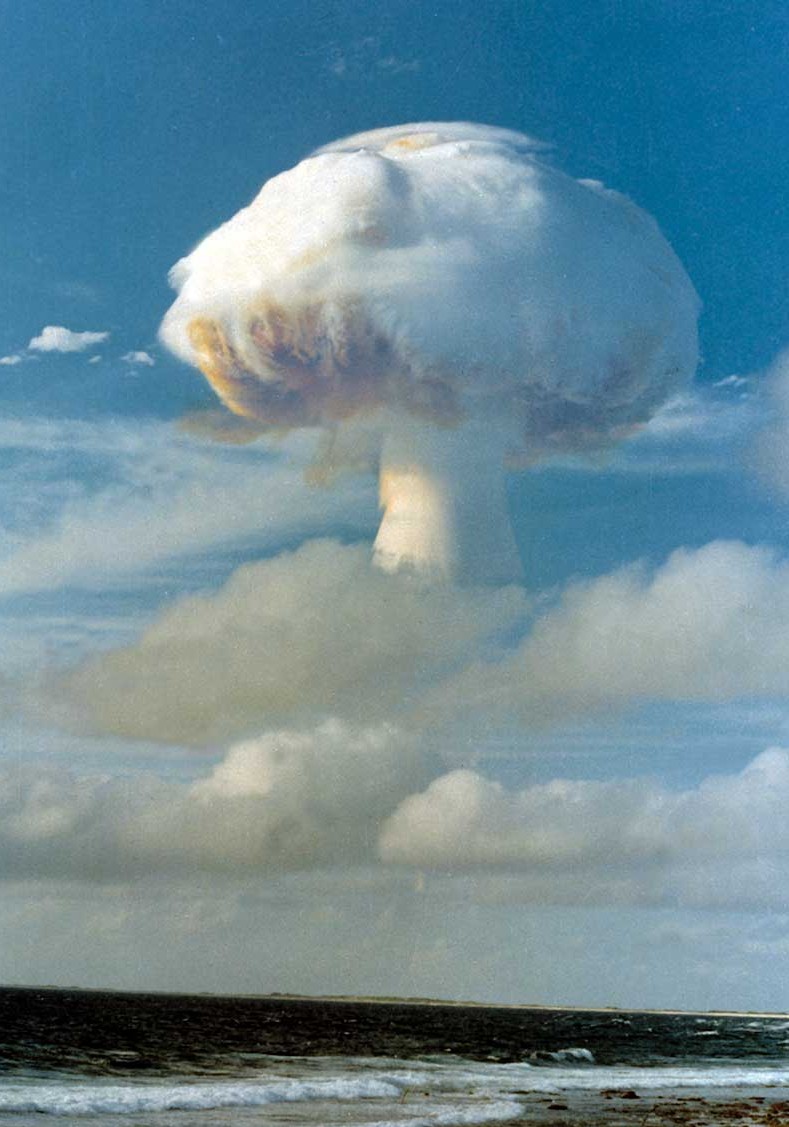
In recent weeks the discussion about nuclear weapons has flamed up again. Russian President Putin has bragged about Russia having developed a “nuclear powered” cruise missile, probably one of the dumbest ideas ever. Donald Trump, not to be outdone by a dumb idea, quickly responded with an even dumber idea. He issued the following proclamation;
The United States has more Nuclear Weapons than any other country. This was accomplished, including a complete update and renovation of existing weapons, during my First Term in office. Because of the tremendous destructive power, I HATED to do it, but had no choice! Russia is second, and China is a distant third, but will be even within 5 years. Because of other countries testing programs, I have instructed the Department of War to start testing our Nuclear Weapons on an equal basis. That process will begin immediately. Thank you for your attention to this matter! PRESIDENT DONALD J. TRUMP
A nuclear-powered cruise missile is self-defeating. Cruise missiles, as the name suggests, are slow and easy to take out, if they can be spotted. That is why cruise missiles are stealthy, they follow the contours of the terrain to evade detection by radar and other sensors. A nuclear-powered cruise missile will be very easy to spot since it will emit radiation that any number of sensors can detect, regardless of how low it flies. It will never reach its’ intended target. Putin’s pronouncement is thus clearly only for domestic consumption, intended to impress the Russian population at a time when the Russians coming under more and more pressure from Ukraine’s attacks on the oil infrastructure. I doubt that any serious military planner in the West is very concerned by it.
Except the notoriously unserious Donald Trump. Almost every statement in his pronouncement is untrue. Russia has more nuclear weapons than the US, but the US has enough to obliterate Russia if needed. The overhauling of the US’s nuclear arsenal was started during the Biden administration. China would need to produce around 1’000 warheads per year to catch up with the US within a decade but is currently only producing a few hundred each year. Only North Korea has tested a nuclear device in the past few decades, no other nuclear power has done so. It is the US Department of Energy that controls the nuclear arsenal, not the Department of War. This is intentionally done to assure civilian control over this most destructive of all weapons.
In a nuclear device, the actual nuclear explosion is the simplest part. It is just a question of pushing enough fissile material together and letting nature take its course. The complicated and difficult parts are the triggering mechanisms and the mechanics of compressing the plutonium or whatever fissile material is used. The US, like any other nuclear power, is constantly testing and improving these mechanisms without the need for an actual nuclear explosion.
That Donald Trump, who has the power to launch nuclear weapons, seemingly does not know that, is a rather frightening thought.
Early in my professional career I worked at RAND, the premier strategic defense thinktank. During WW II, the US was faced with the problem of transferring much of its armed forces across the Atlantic, in as short a time a possible with minimal losses to German submarines. The planners at the Pentagon quickly recognized that this was a mathematical/statistical problem that had to be thought through very carefully. They enlisted the best and the brightest mathematicians and statisticians of the top Universities in the US, put them together in some barracks at Dulles airport near Washington DC, and set them to work on the problem. What these thinkers came up with is essentially the basis of what later became known as multi-object programming or operations research.
After the war, efforts were made to keep this brain trust together. But the scientists were not willing to become government employees, So a group of people from the defense establishment hit upon the idea of setting up a private “not for profit” corporation, that would be organized like any other private enterprise and would be tasked with providing Research And Development (RAND) for the US government, in particular the newly formed air force, on a contract basis. To foster independent thinking, it was to be located as far away from Washington as possible, on the beach in Santa Monica, California.
By the time I joined RAND in 1980, it had grown to about 1’000 employees, roughly divided 50:50 between PhD researchers and support staff. It was still housed in the same barracks as always, but its’ research portfolio had broadened to also encompass research that was not directly related to national defense, but now included civilian topics such as infant mortality in the Philipines, criminal justice etc. To get an overview of the research areas Rand works on today in go to www.RAND.org.
When I joined RAND, about half of its research still concerned national defense topics, in particular a large research program that was known as “Project Air Force”. That was one of the reasons every RAND employee, including myself, was subjected to a background check and had to qualify for and receive a security clearance. A significant portion of RAND’s resources still came from contracts with various departments of the US government. In addition it also received and still receives funding from private institutions such as the Ford foundation, Alfred P. Sloan Foundation etc.
By 1980, the RAND professional staff had grown more diverse as well. No longer was it primarily made up of mathematicians and statisticians but it also included other disciplines such as political scientists and, in particular, economists. Especially the Economics Department, which at that time was headed by Charlie Wolf, had grown considerably. As one of the original RAND researchers once quipped to me over lunch, hiring economists at RAND was an error of the proportion of introducing rabbits to Australia.
One of the original defense contracts for RAND concerned the question of how to respond to the buildup of nuclear weapons by what was then the Soviet Union. The US had demonstrated the devastating effectiveness of these weapons by deploying two of them in Hiroshima and Nagasaki in August 1945. After the war, the Soviet Union started to build up a large arsenal of nuclear weapons, and the US found itself in a relentless arms race with a hostile communist regime. The fear of a third world war, this time with incredibly destructive nuclear weapons, was real.
How to respond? The RAND researchers came up with a strategy that was truly mad. They dubbed it MAD, for Mutually Assured Destruction. If any power were to attack the US with nuclear weapons, the US would respond with a nuclear strike of its own, sufficient for wiping out the aggressor. There was no need for the US to have more nuclear weapons than the Soviet Union, it only needed wo have enough to effectively wipe out the Soviet Union if it were to attack the US or any NATO ally.
Crazy as it sounds, this MAD strategy, pun intended, has kept the peace between the superpowers for the past 80 years. Putin knows that were he to deploy nuclear weapons against any NATO country or even a quasi-NATO country like the Ukraine, he would trigger an assured nuclear response from the US. At least we have to hope he believes that. If Russia were to doubt the US willingness to respond in kind to any nuclear attack or any attack on a NATO country he might be tempted to use some nuclear weapons. This is why some of the more irresponsible utterances by the US Commander in Chief, questening the US commitment to article four of the Nato treaty for example, are so incredibly dangerous. They raise the probability of nuclear war.
We have to believe and pray that the leaders of the nuclear powers are sane and clear sighted and that they understand MAD. The strategy, as developed by RAND, assumes rational actors on all sides. If this is the case, we are in a state of precarious balance. The MAD strategy has worked so far, nuclear war has been avoided. We came close to the brink a few times, such as was the case during the Cuban missile crisis, but overall we have come out ok. Let’s just hope the MAD strategy continues to function the way the RAND researchers, who came up with this idea, imagined.